Vercel vs Netlify: The JAMstack Platform Showdown
Head-to-head comparison for developers choosing between Vercel and Netlify for frontend hosting.
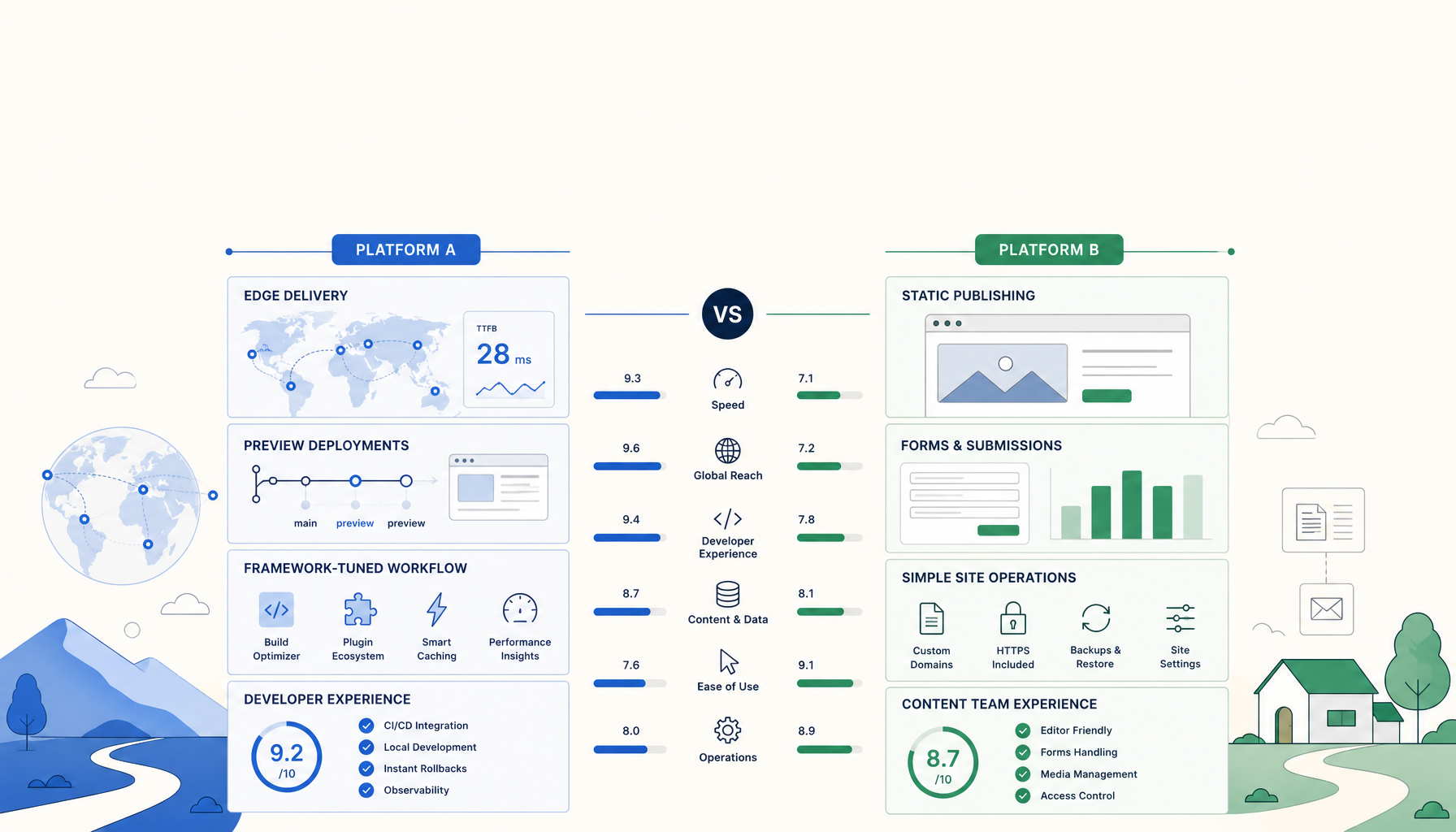
Quick answer: Vercel is the better choice for most modern frontend apps, especially Next.js. Netlify remains strong for static sites with built-in forms and identity.
Comparison Table
| Criteria | Vercel | Netlify |
|---|---|---|
| Pricing | $20/mo Pro + usage | $19/mo Pro + usage |
| Best framework | Next.js (owns it) | Framework-agnostic |
| Edge functions | Mature, global | Available, less mature |
| Build minutes | 6000/mo Pro | 1000/mo Pro |
| Forms | External only | Built-in |
| Identity/Auth | External only | Built-in |
| Verdict | Best for dynamic apps | Best for static + forms |
Vercel Overview
Strengths
- First-party Next.js support (Vercel owns Next.js)
- Superior edge function performance
- Automatic ISR and caching optimization
- More generous build minute allowance
- Better monorepo and workspace support
Weaknesses
- No built-in form handling
- No native authentication service
- Usage-based pricing can spike
- Less suitable for purely static sites
- Bandwidth costs accumulate faster
Best for
- Next.js applications (the obvious choice)
- React-based apps with SSR or ISR
- Teams prioritizing performance over features
- Apps needing edge middleware
Netlify Overview
Strengths
- Built-in form handling without backends
- Native identity and authentication
- Plugin ecosystem for extending builds
- Good for static sites with simple needs
- Split testing built-in
Weaknesses
- Slower edge function adoption
- Less optimized for Next.js specifically
- Lower build minute allowance on Pro
- Falls behind on SSR/ISR features
- Identity service has limitations at scale
Best for
- Static marketing sites
- Sites needing contact forms without backends
- Projects using Gatsby, Hugo, or Eleventy
- Teams wanting auth without external services
When to pick Vercel
Pick Vercel if:
- You are using Next.js (no contest)
- Edge performance is critical
- You need ISR or complex caching strategies
- Build times are long and you need more minutes
- You want the most polished deployment experience
When to pick Netlify
Pick Netlify if:
- You need built-in form handling
- Your site is mostly static with simple dynamic needs
- You want identity/auth without integrating external services
- You are using Gatsby, Hugo, or other static generators
- Split testing is part of your workflow
Verdict
Vercel is the stronger platform for modern frontend development in 2026. If you are building with Next.js, the choice is obvious. Vercel has better edge support, more build minutes, and tighter framework integration.
Netlify still wins for teams building static sites that need forms and basic auth without external dependencies. For everything else, Vercel delivers a better developer experience.
If cost is your primary concern, both platforms get expensive at scale. Consider a VPS-based approach for predictable billing.
Where to go next
Tutorials:
Related comparisons:
ServerCompass: