Best Cheap VPS for Developers (2026): Hetzner, DigitalOcean, Vultr, Linode
A practical comparison of budget VPS providers for developers. Real specs, real prices, and clear recommendations.
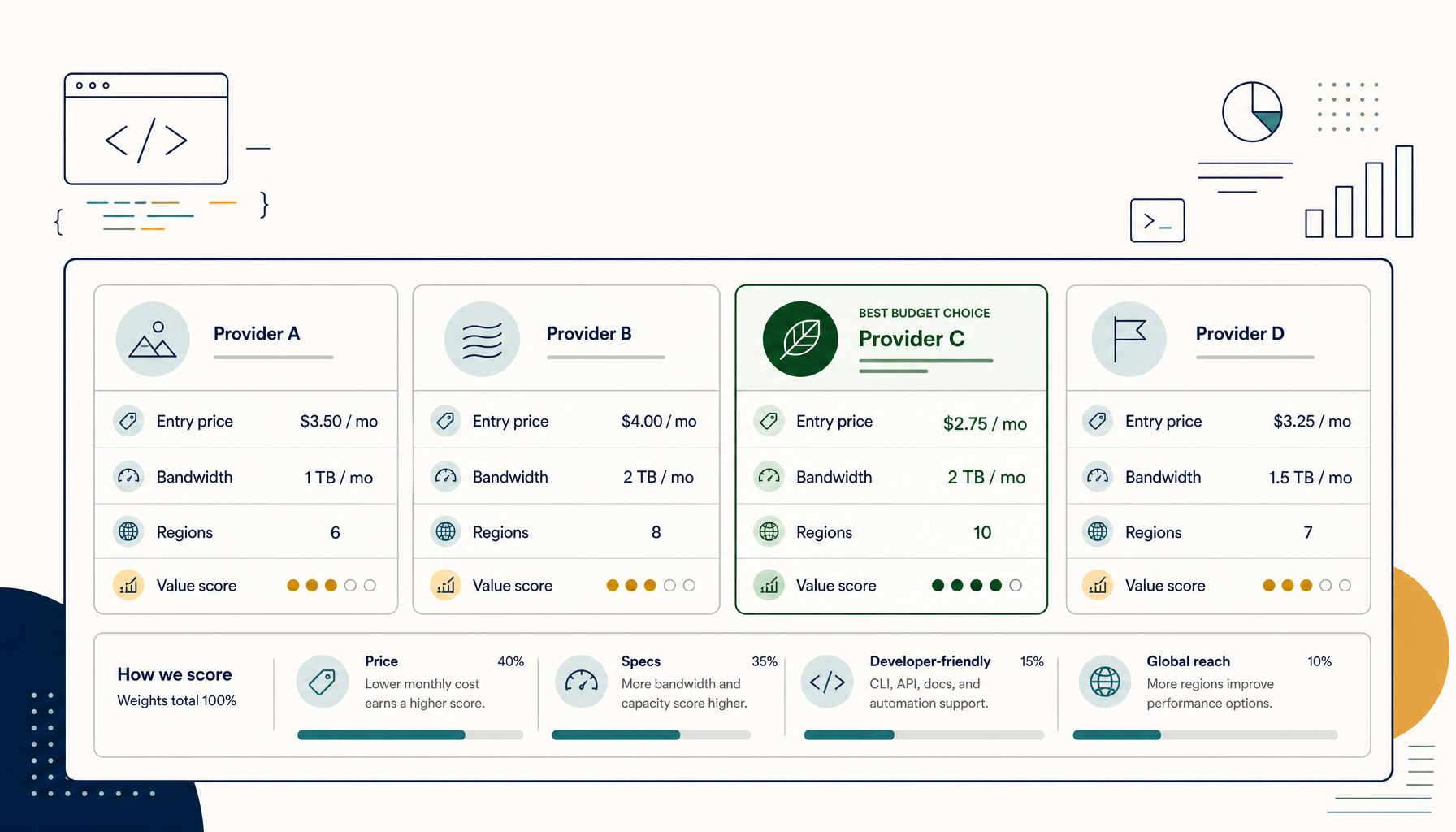
A good VPS is the foundation of cost-effective hosting. One server at $6-12/month can replace $100+/month in PaaS costs.
This is a practical comparison of the best budget VPS options for developers in 2026.
Quick Comparison Table
| Provider | Entry Price | Best Value Tier | Bandwidth | Regions | Best For |
|---|---|---|---|---|---|
| Hetzner | $4.35/mo | CX32 ($7.59) | 20TB | EU, US | Best value |
| DigitalOcean | $6/mo | $12/mo | 2TB | Global | Simplicity |
| Vultr | $6/mo | $12/mo | 2TB | Global | Flexibility |
| Linode | $5/mo | $12/mo | 2TB | Global | Reliability |
The Winner: Hetzner
For pure price-to-performance, Hetzner wins. The specs and bandwidth are significantly better than US competitors at the same price.
However: If you need US-based servers with more datacenter options, DigitalOcean or Vultr are solid choices.
Hetzner Cloud
Hetzner is the European provider that US developers discovered. The value is hard to beat.
Pricing:
| Instance | vCPU | RAM | Storage | Price |
|---|---|---|---|---|
| CX22 | 2 | 4 GB | 40 GB | $4.35/mo |
| CX32 | 4 | 8 GB | 80 GB | $7.59/mo |
| CX42 | 8 | 16 GB | 160 GB | $14.49/mo |
Strengths:
- Best specs per dollar
- 20TB bandwidth included (competitors offer 2-4TB)
- Clean, fast control panel
- Reliable uptime
- US datacenter in Ashburn, VA
Weaknesses:
- Fewer datacenter locations than competitors
- Less "ecosystem" (managed databases, etc.)
- Support is functional, not premium
Best for:
- Cost-conscious developers
- High-bandwidth applications
- European-focused projects
DigitalOcean
DigitalOcean pioneered developer-friendly VPS. Still a solid choice, just not the cheapest.
Pricing:
| Instance | vCPU | RAM | Storage | Price |
|---|---|---|---|---|
| Basic | 1 | 1 GB | 25 GB | $6/mo |
| Basic | 1 | 2 GB | 50 GB | $12/mo |
| Basic | 2 | 4 GB | 80 GB | $24/mo |
Strengths:
- Excellent documentation
- Large ecosystem (managed databases, Kubernetes, app platform)
- Many datacenter locations
- Good community and tutorials
- Reliable and well-established
Weaknesses:
- More expensive than Hetzner for same specs
- 2TB bandwidth vs Hetzner's 20TB
- Pricing has crept up over the years
Best for:
- Developers who value ecosystem and docs
- Projects needing managed add-ons
- Teams already familiar with DO
Vultr
Vultr is the flexible middle ground. Competitive pricing with global reach.
Pricing:
| Instance | vCPU | RAM | Storage | Price |
|---|---|---|---|---|
| Cloud Compute | 1 | 1 GB | 25 GB | $6/mo |
| Cloud Compute | 1 | 2 GB | 55 GB | $12/mo |
| Cloud Compute | 2 | 4 GB | 80 GB | $24/mo |
Strengths:
- 32 datacenter locations worldwide
- Hourly billing
- Good API
- Bare metal options
- Competitive pricing
Weaknesses:
- Less polished than DigitalOcean
- Smaller community
- Documentation is adequate, not great
Best for:
- Global deployments needing many regions
- Developers who want flexibility
- Projects needing bare metal
Linode (Akamai)
Linode was acquired by Akamai but maintains its developer focus. Reliable and straightforward.
Pricing:
| Instance | vCPU | RAM | Storage | Price |
|---|---|---|---|---|
| Nanode | 1 | 1 GB | 25 GB | $5/mo |
| Linode 2GB | 1 | 2 GB | 50 GB | $12/mo |
| Linode 4GB | 2 | 4 GB | 80 GB | $24/mo |
Strengths:
- Long track record of reliability
- Good support reputation
- Straightforward pricing
- Akamai CDN integration
Weaknesses:
- Similar pricing to DigitalOcean (more expensive than Hetzner)
- Fewer managed services than DO
- Interface feels less modern
Best for:
- Teams prioritizing reliability over cost
- Long-term projects needing stable provider
- Akamai CDN users
Detailed Feature Comparison
| Feature | Hetzner | DigitalOcean | Vultr | Linode |
|---|---|---|---|---|
| Entry price | $4.35 | $6 | $6 | $5 |
| 4GB RAM tier | $4.35 | $24 | $24 | $24 |
| 8GB RAM tier | $7.59 | $48 | $48 | $48 |
| Bandwidth | 20TB | 2-4TB | 2-3TB | 2-4TB |
| Datacenter count | 5 | 15 | 32 | 11 |
| Managed DB | No | Yes | Yes | Yes |
| Kubernetes | No | Yes | Yes | Yes |
| API quality | Good | Excellent | Good | Good |
| Docs quality | Good | Excellent | Adequate | Good |
Real Cost Examples
Side project (blog, portfolio, small app)
| Provider | Instance | Monthly |
|---|---|---|
| Hetzner | CX22 | $4.35 |
| DigitalOcean | Basic 1GB | $6 |
| Vultr | Cloud 1GB | $6 |
| Linode | Nanode | $5 |
Winner: Hetzner at $4.35 for 2 vCPU, 4GB RAM
Small SaaS (API, database, workers)
| Provider | Instance | Monthly |
|---|---|---|
| Hetzner | CX32 | $7.59 |
| DigitalOcean | Basic 4GB | $24 |
| Vultr | Cloud 4GB | $24 |
| Linode | Linode 4GB | $24 |
Winner: Hetzner at $7.59 for 4 vCPU, 8GB RAM
Growing startup (production workload)
| Provider | Instance | Monthly |
|---|---|---|
| Hetzner | CX42 | $14.49 |
| DigitalOcean | Basic 8GB | $48 |
| Vultr | Cloud 8GB | $48 |
| Linode | Linode 8GB | $48 |
Winner: Hetzner at $14.49 for 8 vCPU, 16GB RAM
My Recommendation
For most developers: Start with Hetzner. The value is unmatched. A CX32 at $7.59/mo gives you 4 vCPU and 8GB RAM, which costs $48/mo at competitors.
If you need US presence: Hetzner has an Ashburn, VA datacenter. If you need West Coast or more US options, consider Vultr for region flexibility or DigitalOcean for ecosystem.
If you want managed services: DigitalOcean has the best ecosystem. Managed databases, Kubernetes, and App Platform are useful if you want less DIY.
For reliability focus: Linode has the longest track record. If stability matters more than cost optimization, it is a safe choice.
Getting Started
- Create an account at your chosen provider
- Spin up the smallest instance that fits your needs
- Install Docker:
curl -fsSL https://get.docker.com | sh - Deploy with Docker Compose or a self-hosted PaaS
Most developers are running production apps within an hour.
Where to go next
Pricing:
Comparisons:
Best of:
Tutorials:
ServerCompass:
Related in the StoicSoft network
If you're choosing a VPS provider or benchmarking real-world performance like the post above explores, StoicVPS is the StoicSoft network's independent tracker for VPS pricing, performance, and migration safety.