Hetzner vs DigitalOcean: VPS Value Showdown
Head-to-head comparison of the two most popular VPS providers for developers. One wins on price, the other on ecosystem.
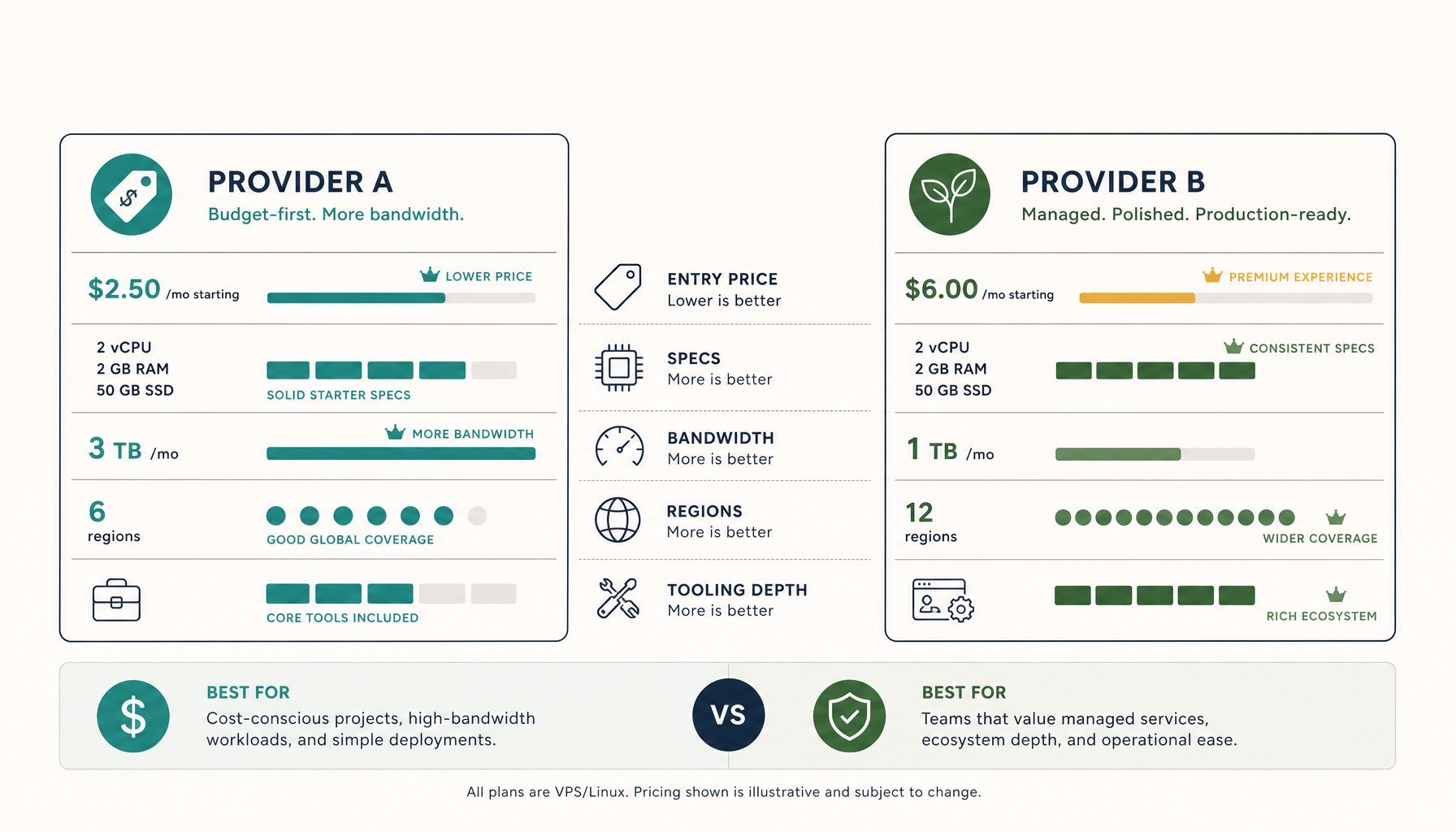
Quick answer: If cost matters, Hetzner wins. If you need US data centers, managed services, or a larger ecosystem, DigitalOcean is the safer choice.
Comparison Table
| Criteria | Hetzner | DigitalOcean |
|---|---|---|
| Starting price | $4.50/mo (2 vCPU, 4 GB) | $6/mo (1 vCPU, 1 GB) |
| Best value tier | $7.50/mo (4 vCPU, 8 GB) | $24/mo (2 vCPU, 4 GB) |
| Data centers | EU (Germany, Finland), US (Ashburn) | US, EU, Asia, Australia |
| Bandwidth | 20 TB included | 1-6 TB (varies by plan) |
| Managed databases | No | Yes (PostgreSQL, MySQL, Redis) |
| Kubernetes | No managed option | Yes (DOKS) |
| Block storage | $0.052/GB | $0.10/GB |
| Support | Email only (free tier) | Ticket + community |
Hetzner Overview
Hetzner is a German hosting company known for aggressive pricing and solid infrastructure. They've been around since 1997 and have a strong reputation in Europe.
Strengths
- Price-to-performance ratio is unmatched. A 4 vCPU, 8 GB RAM server costs $7.50/mo. The same specs on DigitalOcean cost $48/mo.
- Generous bandwidth. 20 TB included on all plans. DigitalOcean charges for overages much sooner.
- Dedicated vCPU options. For workloads that need consistent performance, Hetzner's dedicated CPU plans are significantly cheaper.
- ARM servers available. Ampere ARM64 servers at even lower prices for compatible workloads.
Weaknesses
- Limited US presence. Only one US data center (Ashburn, Virginia). If you need US West or other regions, you're out of luck.
- No managed services. No managed databases, no managed Kubernetes. You're on your own for the ops layer.
- Support is basic. Email only on free tier. No live chat, no phone support.
- Smaller ecosystem. Fewer one-click apps, fewer integrations, smaller community.
Best for
- Cost-conscious teams running their own infrastructure
- European companies with EU data residency requirements
- High-bandwidth applications (video, backups, CDN origins)
- Developers comfortable with self-managed infrastructure
DigitalOcean Overview
DigitalOcean is a US-based cloud provider that popularized the "developer-friendly VPS" category. They've expanded into managed services and Kubernetes.
Strengths
- Global presence. Data centers in US (multiple), EU, Asia, and Australia. Better for global latency.
- Managed services. Managed PostgreSQL, MySQL, Redis, and Kubernetes. Less ops burden.
- Larger ecosystem. More one-click apps, Terraform provider, extensive documentation.
- Better for teams. Team management, invoicing, and organization features are more mature.
Weaknesses
- 2-3x more expensive. For raw compute, you're paying a significant premium over Hetzner.
- Bandwidth limits. 1-6 TB depending on plan. Overages add up quickly for high-traffic apps.
- Block storage is expensive. $0.10/GB vs Hetzner's $0.052/GB.
- Performance variability. Shared CPU instances can have noisy neighbors.
Best for
- Teams that want managed databases and Kubernetes
- Companies with global users who need multiple regions
- Startups that prioritize ecosystem and ease over cost
- Projects with moderate bandwidth needs
When to Pick Hetzner
Pick Hetzner if:
- Cost is a primary concern. The savings are substantial: 50-70% less for equivalent specs.
- You're comfortable with ops. No managed databases means you're running PostgreSQL yourself.
- Your users are in Europe. Hetzner's EU data centers have excellent connectivity.
- You have high bandwidth needs. 20 TB included is hard to beat.
- You want dedicated CPU. Hetzner's dedicated options are much cheaper.
When to Pick DigitalOcean
Pick DigitalOcean if:
- You need managed services. Managed databases and Kubernetes reduce ops burden significantly.
- You have global users. More regions mean better latency worldwide.
- You're a larger team. Better team management and enterprise features.
- You value ecosystem. More integrations, one-click apps, and community resources.
- You need US West or Asia. Hetzner doesn't have these regions.
Real Cost Comparison
Small startup (2 servers, database, 5 TB bandwidth)
| Provider | Monthly Cost |
|---|---|
| Hetzner | ~$25/mo (self-managed DB) |
| DigitalOcean | ~$80/mo (managed DB) |
Growing SaaS (4 servers, managed DB, 10 TB bandwidth)
| Provider | Monthly Cost |
|---|---|
| Hetzner | ~$60/mo (self-managed) |
| DigitalOcean | ~$200/mo (managed) |
The gap widens as you scale. Hetzner's savings compound.
Verdict
Hetzner wins for most developer use cases.
If you're a solo developer or small team that can manage your own infrastructure, Hetzner's value is hard to ignore. The 50-70% cost savings add up to thousands of dollars per year.
DigitalOcean wins if you need:
- Managed databases (don't want to run Postgres yourself)
- Multiple global regions
- Kubernetes without the setup overhead
- A larger ecosystem and community
For most projects starting out, I'd recommend Hetzner + self-managed PostgreSQL. When you grow and ops becomes a bottleneck, consider DigitalOcean's managed services or hire an ops person.
Where to go next
Tutorials:
Related comparisons:
ServerCompass:
Related in the StoicSoft network
If you're choosing a VPS provider or benchmarking real-world performance like the post above explores, StoicVPS is the StoicSoft network's independent tracker for VPS pricing, performance, and migration safety.